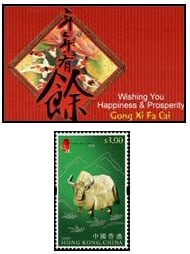
This year the date for the Chinese New Year was January 26th, 2009. The Chinese have been calculating the New Year for a long time; this year was be 4707 in the Chinese counting system.
Funny Chinese Sayings and Quotes
Will and Guy bring you these phrases, sayings and quotations translated from the Chinese to amuse and entertain you; perhaps you will find them thought provoking, also.
- Success means competition.
- An old pot is the best around the kitchen.
- One must be available, alert, active, and adaptable.
- If you have many best friends, you have no friends.
- Mountains can move, but not your character.
- Concern yourself about others more than yourself.
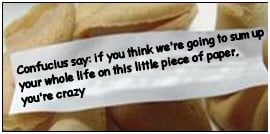
- Confucius say: if you think we’re going to sum up your whole life on this little piece of paper, you’re crazy.
More Chinese Sayings
- A nice person who is bad-tempered and foul-mouthed is not considered as a good person.
- Knowledge must be realised to become one’s wisdom.
- Love is not demanding but giving.
- Our greatest enemy is not another person, perhaps it is our own self.
- See who loves the other one more, and not who fears the other one more.
- The consumers of time while away their time: The creators of life are dynamic and are assets to others.
- Be patient kind and loving: Don’t worry and don’t fret.
- One who always looks for excuses cannot progress.
- Weeds do not grow easily on land grown with vegetables: Evil thoughts do not arise easily in a mind filled with kindness.
Chinese Proverbs
- Man with one chop stick go hungry.
- Man who drive like hell bound to get there.
- Chinese money proverb
- Chinese ‘Cracked Pot’ parable
How To Speak Chinese Funny
- It’s very dark in here………………………Wai So Dim?
20 Number 6

It’s a Dog’s Life
Meanwhile, Bill and Jackson’s wives decided to dine out a new Chinese Restaurant. Jackson’s wife Julie was inseparable from her Pekingese dog called ‘Pepe’. So Took took Pepe along with them to the restaurant. Whenever they went to their usual restaurant the manager’s wife looked after Pepe while they ate, and they thought it would be no different this new restaurant.
One-liners
Share Good Wishes for Prosperity and Good Luck in 2009
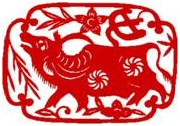
At the Chinese New Year on January 26th in 2009, you can do better than just saying Happy New Year, you can share the following good wishes with your Chinese friends:
新年快乐 xīn nián kuài lè = Happy New Year
过年好 ɡuò nián hǎo = Happy New Year
恭喜发财 ɡōnɡ xǐ fā cái = I wish You Great Prosperity
牛年吉祥 niú nián jí xiáng = Good Luck in the Year of the Ox
Chinese food served at the New Year has particular symbolism
- Most of the dishes served during Chinese New Year are symbolic of something positive and hopeful.
- Chicken and fish, for example, symbolize happiness and prosperity, especially when served whole.
- Dishes made with oranges represent wealth and good fortune because they are China’s most plentiful fruit.
- Noodles represent longevity: therefore, they should never be cut.
- Duck symbolizes fidelity, while eggs signify fertility.
- Bean curd or tofu, however, is avoided because its white colour suggests death and misfortune.
Chinese Food for 2009 New Year
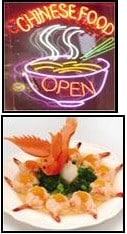
Dishes are also chosen based on homonyms; words that either are spelled the same or sound the same as other words. Fish [yu] is served because it sounds similar to the Chinese word for plenty, or profit [surplus]; whole fish represents a long life and good fortune. Turnips are cooked because their name [cai tou] also means ‘good luck.’
Another popular Chinese New Year dish is jiaozi, which is dumplings boiled in water. In some areas of China, coins are placed in the centre of jiaozi. Whoever bites into one of these dumplings will have an exceptionally lucky year.
Chinese New Year food is all about symbols, symbols denoting prosperity, good luck, fortune and health. This photo [right] shows Happy Jumping Shrimp.
For The Chinese New Year – The Colour Red and Fireworks
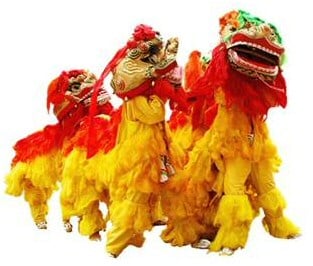
At the Chinese New Year (January 26th, 2009) red is important. People wear red clothes, they write poems on red paper, and give children ‘luck money’ in red envelopes. The symbolism behind the red colour is fire, and fire burns off bad luck. As for fireworks one belief is that the cracker jacks and sparks frighten away evil spirits.
Chinese New Year Stories
The Story of Nian
Our friend, Chou told Will and Guy this story about the beast, that lives under the sea or in the mountains, who often appears on New Year’s eve to attack people, particularly children – however, as luck may have it some things frighten him.
A long time ago during the age of great floods, and when the world was not a safe place, there was a vicious monster named Nian. Whenever the thirtieth day of the last lunar month arrived this monster would rise up out of the sea or he would come down from the mountains killing people and wreaking havoc in their fields and gardens. The people would bar their doors before dark and sit up all night, terrified. The next day they would leave their homes to greet their neighbours and congratulate them on surviving.
Once on the last night of the last month, legend has it, Nian suddenly burst into a small village devouring almost all the people who lived there. Only two families emerged unscathed.
The first were a newlywed couple who avoided harm because their celebratory red wedding clothes resembled fire to the monster, so it did not dare to approach them.
The other family was unharmed because their children were playing outside setting off noisy firecrackers and the noise scared the monster away.
Ever since then Chinese people have worn red clothes, set off firecrackers and put up red decorations on New Year’s Eve to keep the vicious monster Nian away.
The Chinese Story of the New Year Animals
This is a story from China. It is about twelve animals: a dog, a pig, a rat, an ox, a tiger, a hare, a dragon, a snake, a horse, a ram, a monkey and a cockerel.
One day the twelve animals were having an argument. They wanted every year to have a name. ‘I think that this year should be named after me,’ barked the dog. ‘It should be called the year of the Dog.’
‘No.’ gibbered the monkey, ‘I think this year should be named after me.’ said the monkey. ‘It should be called the Year of the Monkey.’
‘No, no,’ breathed the dragon. ‘This year should be named after me. It should be called the Year of the Dragon.’
The gods were listening. They heard the animals arguing. ‘Stop arguing,’ demanded one of the gods. The dog stopped arguing. The monkey stopped arguing. The dragon stopped arguing. They all stopped arguing and listened. The gods boomed, ‘Can you see the big river? You must have a race across the big river. We will name this year after the winner of the race.’
So, all the animals lined up on the bank of the river ready for the race. They’re off! The animals jumped into the water and swam as fast as they could towards the other side.
The ox was very strong and he could swim very fast. Soon he was in front of all the other animals; but the rat was very clever. He grabbed the ox’s tail and climbed onto his back. The ox didn’t know he was there.
The ox thought he was going to win the race. Just before the ox got to the other side, the rat jumped off the ox’s back onto the grass and won the race.
‘Yippee! Hoorah!’ shouted the rat, ‘I’m first.’
The ox was very surprised. ‘How did you do that?’ he asked, but the rat only laughed.
The gods laughed too and said, ‘The rat is the winner. We will call this year the Year of the Rat. The ox was second, so next year will be called the year of the Ox.
All the other animals finished the race. The tiger was third, the hare was fourth, the dragon was fifth, the snake was sixth, the horse was seventh, the ram was eighth, the monkey was ninth, the cockerel was tenth, the dog was eleventh and the pig was last.
The gods decided that each year would be named after one of the animals in the race. The animals didn’t argue any more. They were very happy, especially the rat because he had won the race.
Chinese New Year Masks
Masks in Chinese culture are part and parcel of the world culture of masks……. 面具 Mianju. Masks first appeared in China during the Shang and Zhou dynasty some 3,500 years ago. The colourful and exciting celebrations for the Chinese New Year last for several days and end with the lantern [Yuanxiao] festival.
Materials in Chinese New Year Masks
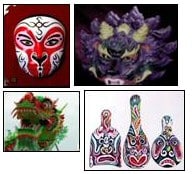
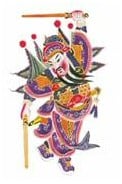
Chinese New Year Masks are made of varied materials including cloth, paper, grass, leather, metal, shell, and carved of stone or wood. They are painted with Chinese symbolic designs and vivid colours. Some masks have realistic human or animal features like lion or dragon, while others provide a grotesque appearance. Red is considered as a lucky colour for Chinese people, therefore there are lots of red masks worn during the celebrations of New Year. Chinese New Year Masks are amongst the best creations in the art world and are highly sought after by art collectors.
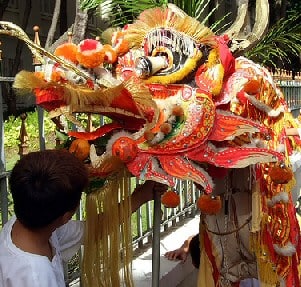
Many of the masks or sometimes replicas, can be viewed in museums and art galleries in many parts of the world. Chinese New Year is swathed in beliefs of gods, spirits of ancestors, legendary beings, good and or evil, the dead, animal spirits, and other beings believed to have supreme power over humanity. Masks featuring such supreme powers are honoured and are worn during the rituals surrounding the Chinese New Year like the Chinese new year dragon dance or lion dance. Chinese New Year Masks are also hung around the home as decoration.
Lantern festival held in London, England
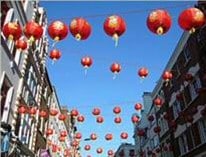
The traditional food for the Lantern Festival is Yuanxiao dumplings, named after the lonely palace maid of long ago. [Some versions of the story have her preparing stuffed dumplings for the God of Fire, as this was one of his favourite foods]. Yuanxiao are made with sticky rice flour. They can be sweet or savoury; filled with everything from sugar, walnuts, and dried tangerine peel to meat and vegetables.
Chinese New Year Masks display the feelings and emotions of merriment associated with this festival. Chinese people all over the world usher in the New Year by cooking special food, cleaning their homes, purchasing new clothes and buying presents for friends and family. In the midst of all these activities, various artworks like Chinese New Year Masks in rich colours display the essence of the festivity.
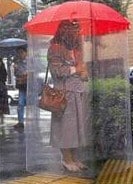
If it Rains: Fun Chinese Umbrella
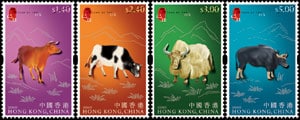
Stamps Showing the Chinese Year of the Ox
Chinese Phrases
搞笑清洁笑话 in China roughly translates into clean funny jokes.
Chinese Characters
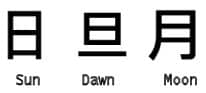
A simple example of Chinese characters showing how the sun symbol can be modified with a line to mean dawn.
P.S. Please write to Will and Guy if you have any examples of funny Chinese sayings.