Piltdown Man
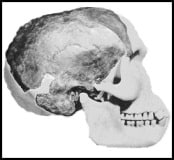
Perhaps the most famous impostor or hoax was Piltdown man. At a time when Darwin’s evolutionary theory was new, and people were looking for missing links between human’s and apes, someone planted the Piltdown Man fake in 1912.
Piltdown, where the part medieval man part Orang-utang fossil was found, is a village in Sussex. Piltdown man’s scientific name, Eoanthropus dawsoni, reflected its finder’s name Dawson. To get a flavour of those times, the British empire was still riding high, and Germany had their Heidelberg man fossil, Britain was desperate for a more important ‘missing link’ between man and monkey.
The hoax lead a charmed life until it was unmasked in 1953. Piltdown man was literally put an a pedestal and worshipped but not rigorously examined. Microscopic examination, X-rays, or carbon dating would have exposed the fraud the impostor much earlier.
Who did it?
What is so appealing about the Piltdown fraud is that the hoaxer was never exposed, certainly during their life time. Much like horses at the nearby Plumpton race track, a whole field of suspects has been assembled for the hoax of the 20th century. The most exotically named is Pierre Teilhard de Chardin a friend of Dawson and a Jesuit. One of the outsiders in the betting is Sir Arthur Conan Doyle, the creator of Sherlock Homes.
The favourite to be the hoaxer is Dawson who discovered the fossil. Dawson was an antiquarian, therefore had access to exotic skeleton’s from which to build the two fraudulent skulls known as Piltdown I and Piltdown II. Dawson also had the knowledge of chemistry needed to age the skull to look like a fossil.
From the Times January 11th
Main Story.
This man won a medal for rescuing people from a burning plane. Yesterday he admitted telling a pack of lies By Simon de Bruxelles and Lewis Smith FOR a year Nigel Gallimore was hailed as a hero for his daring rescue of two men from a blazing plane.
Yesterday the window cleaner was forced to admit in a coroner’s court that he had lied about his exploits, having stolen his rescue story from the real rescuer who had preferred to keep his bravery quiet.Mr Gallimore, 41, now faces the ignominy of having to return his Queen’s Commendation for Bravery, which was awarded after his boasts of a dramatic rescue.
In fact, he had arrived on the scene too late to do much more than help to move one of the badly burnt victims on to a grass verge. But he claimed in a statement and on television that he had helped them from the blazing wreckage seconds before the aircraft exploded in a ball of flame.
The real hero, Mike Winstanley, who risked his life to save the pilot and one of his passengers, called for Mr Gallimore to be stripped of the medal awarded by the Queen.
Mr Winstanley, a former corporal in the Royal Green Jackets, dived into the flames without a thought for his own safety when the light aircraft crashed soon after taking off from Bournemouth International Airport in 2004.
At the inquest into the death of a third man on the plane Mr Gallimore admitted that he had “embellished” the account, which appeared on local television and in the local press. He had repeated his tale in a statement to the Air Accident Investigation Branch, which led to him being awarded the highest award available to civilians after the George Medal.
At the inquest on Andrew Anderson, 41, a financial adviser who was on his way to an air show with friends from Guernsey, Mr Gallimore admitted: “In the heat of the moment I probably said things that didn’t happen.”.
Mr Winstanley, who also attended the inquest at Bournemouth Town Hall, said: “If he was decent, he would have handed the award back. I am not saying I am a hero or that I deserve an award, but I was in the right place at the right time and just did what any normal person would do. The police have statements from witnesses and they all confirm that I did it.”.
According to Mr Winstanley, Mr Gallimore, who had been at an amusement park with his wife and child, arrived after the survivors had been rescued from the wreckage. The men whose lives Mr Winstanley helped to save — Rob Le Page, the pilot, and Dave Bougard, a passenger — were both on fire when he helped them from the crash and he beat out the flames with his hands.
The coroner asked Mr Winstanley whether anyone else helped him. “No one,” he replied.
The story of the rescue almost exactly mirrors the plot of Accidental Hero, the 1992 film in which Dustin Hoffman rescues passengers from a crashed airliner only to see Andy Garcia claim the credit — and a $1 million reward.
In his summing up Sheriff Payne, the Bournemouth, Poole and East Dorset Coroner, made no mention of Mr Gallimore’s admission, but he said: “This has been slightly unusual in some aspects. I will not comment any further.”.
Last night Mr Gallimore insisted that he did deserve the award and would not be handing it back. He said that the contradictory statements were the result of him forgetting some of the details of what had happened. However, he admitted exaggerating his role.“It was a little bit embellished but I did go to help,” he said. “I am not bothered about what has been said. I felt a bit guilty but I did help.
I told the people who gave out the medal that others should have got them and I only went because my name was put forward.”.
A spokeswoman for the Cabinet Office, which is responsible for the Queen’s Commendations, said the award could be taken back. She said: “Forfeiture may be considered if evidence on which an award is given turns out not to be true.”.
Dorset Police are considering investigating Mr Gallimore’s original claims.
A verdict of accidental death was returned on Mr Anderson
Other Hoaxes
Bruce Cotta, claimed to have won the Distinguished Service Cross during the Vietnam War. A post office on Rhode Island was named after him. However it came to light, that Cotta bought the medal on the internet. The honour was rescinded and the post office renamed.
Tom Carew, who sold 50,000 books of his account of service with the SAS in Afghanistan, was actually Philip Sessarego who failed selection for the service.
Ged Slater from Newcastle was jailed for 3½ years after putting flashing lights on his car and dressing as a paramedic in order to conduct intimate examinations of women involved in accidents.
New York fire chief Richard Picciotto claimed he rescued a woman in the World Trade Centre on 9/11. He actually fabricated his story from the statements of real rescuers
˚