Art is a collaboration between God and the artist, and the less the artist does the better. Andre Gide
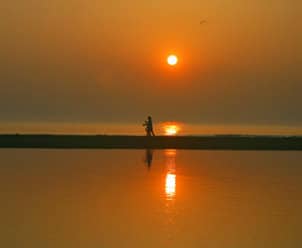
Last Walk on the Beach
These photographs make interesting use of light. See how they show beams of light shining through clouds, in the late afternoon.
Picture of Sunset or Sunrise Over the Sea
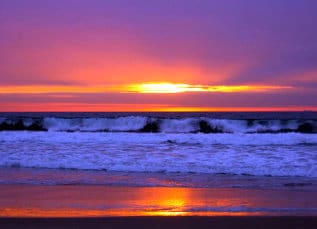
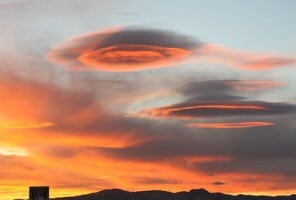
Clouds Like UFOs – Interesting Picture of Sunset
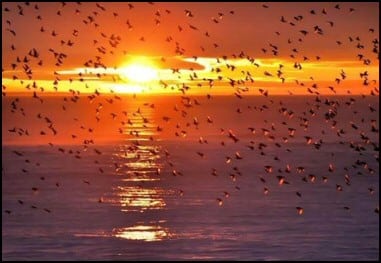
Jim Bainbridge: ‘Driving through Nevada we came across the most amazing tree with resting birds photo taken by Michael D Johnson, Sacramento, California.
Sunset in Aberystwyth
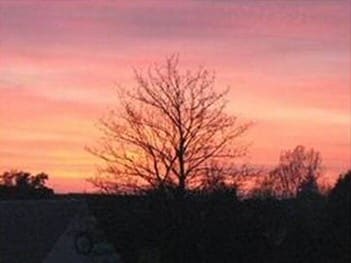
Above sunset photo taken by Maggie Nutt from her front door.
Dazzling Picture of a Sunset in Utah
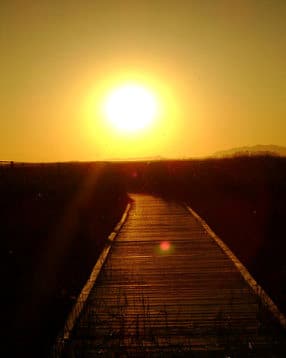
An enormous sunset – Photographed in the ‘Magic Hour’ Before Sundown.
Capture the Sun
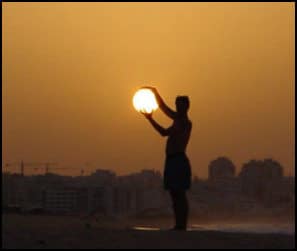
Colorado Sunset or Sunrise?
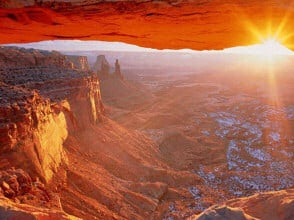
Beautiful sunset at Mesa Arch, Canyonlands National Park state of Utah, USA. [Thanks Lbow]
Useful Clarification of Sunset, Sunrise and Twilight
A sunrise: This is when the top of the sun appears on a sea-level horizon.
A sunset (Sundown): Occurs when the top of the sun just disappears below the sea-level horizon.
Dusk: The sun has set, the sky is darkening, but there is still some blue in the heavens.
Twilight: A time of day when there is light in the sky, but the sun is not yet visible. Thus it could refer to the time just before sunrise, or just after sunset. Furthermore, there are three ‘grades’ twilight.
Civil Twilight: The sun is no more than 6 degrees below the horizon at either sunrise or sunset. You can still see the horizon, yet should be able to make out the brightest stars, especially if there is no moonlight. One still should be able to carry on ordinary outdoor activities.
Nautical Twilight: Now the sun is between 6 and 12 degrees below the horizon at either sunrise or sunset. You cannot make out the horizon. You need extra light for ordinary outdoor activities.
Astronomical Twilight: This is dark; the sun is between 12 and 18 degrees below the horizon at either sunrise or sunset. Under ideal conditions you should detect faint sky illumination, a sense that dawn is near.
Sunset Calendars
You can find detailed information about the timings and dates of sunsets and sunrises for your location here:
Panoramic Picture of Sundown
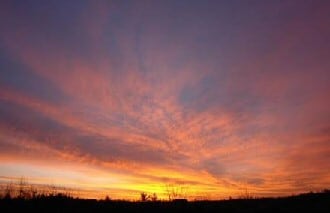
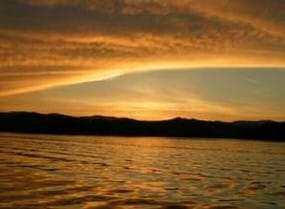
Sunset in Indonesia
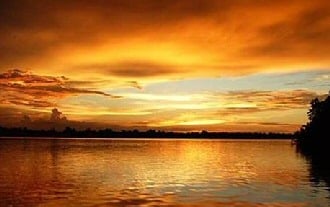
An amazing colour sunset taken from a boat on a river near Damai, Borneo, Indonesia. This beautiful photo was taken by Sarah Sheldon
Mackerel Sky at Sunset (Altocumulus clouds)
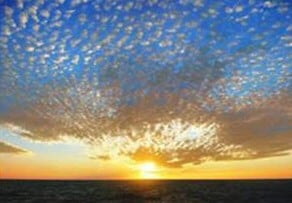
Sunset Over Water
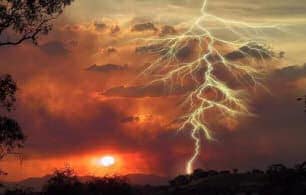
Picture of Sunset with Lightning
Special Sunsets At the Full Moon
Whereas we just admire pictures of sunsets, our ancestors realized that this was a good time to go out and catch their supper. They were also aware that the combination of a full moon and sunset was a deadly combination, deadly for rabbits, deer or other tasty quarry.
Modern man, especially those living in cities or suburbia are out of tune with nature in general and sunset in particular. The full moon and sunset have special significance. Due the laws of astronomy the full moon rises magically shortly after sunset. Our forbears even appreciated that at the autumn (and spring) equinox the time between sunset and the full moon rising was only 25 minutes, shorter than at mid-summer, or mid-winter.
The point is that our crafty ancestors realized that these conditions would favour the hunter over the hunted. The upshot is that they named the first moon after the autumnal equinox, ‘Hunter’s moon’. Furthermore from medieval times onwards countrymen called the full moon after that ‘Poacher’s moon’.
Incidentally, the Chinese call the full moon after the equinox Zhongqiujie and have a lantern festival in its honour.
Picture of Moon at North Pole Sunset
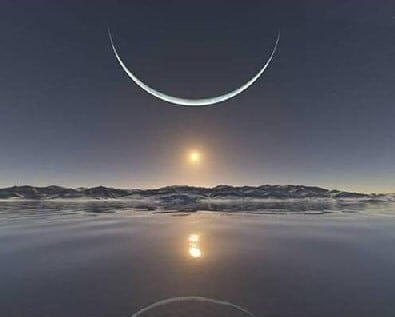
This is a sunset at the North Pole. What is also interesting is the moon, which looks so huge. The photograph was taken on May 11, 2009 at a time when the moon appears nearest to the sun at this extreme latitude.
Sunset Timing
The time of sunrise and sunset varies with day of the year, latitude, and longitude. The published sunrise and sunset times are calculated without regard to surrounding terrain. That is, all computations are made for a sea-level horizon, even in mountainous areas. Thus the actual time of sunrise at a particular location may vary considerably from the ‘official’ times.
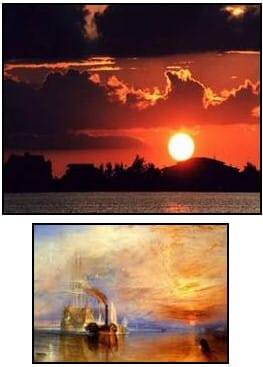
The Rayleigh Effect
The red hues seen in the sky at both sunset and sunrise are caused by the Rayleigh* effect. This is caused by the scattering of blue light. Whereas there is relatively little scattering of red light consequently the sky takes on shades of red, orange and yellow.
I expect that you have noticed how sunset is more brightly coloured than the sunrise. This is because all the hours of daylight results in more dust in the lower atmosphere at evening than at dawn.
*The blue colour of the sky is caused by the scattering of sunlight off the molecules of the atmosphere. This scattering, called Rayleigh scattering, is more effective at short wavelengths [the blue end of the visible spectrum]. Therefore the light scattered down to the earth at a large angle with respect to the direction of the sun’s light is predominantly in the blue end of the spectrum.
Some of the most spectacular sunsets occur after volcanic eruptions such as Mount Pinatubo in 1991 and Krakatoa* in 1883. Moreover, this is not just a local effect, volcanoes cause spectacular sunsets and sunrises all over the world. Sometimes just before sunrise or after sunset a green flash can be seen.
See sunset picture to the right of British artist JMW Turner’s painting after Krakatoa erupted.
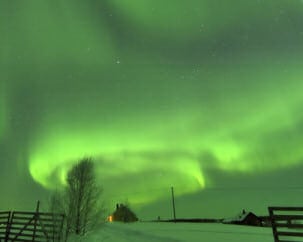
Northern Lights (Aurora Borealis)
The Northern Lights photographed by Max Pickering inside the Arctic Circle in northern Finland. The light effect is caused by electrons and protons from the magnetosphere colliding with particles in the earths upper atmosphere. What causes the swirling patterns is winds circulating in the Earth’s outer layers.
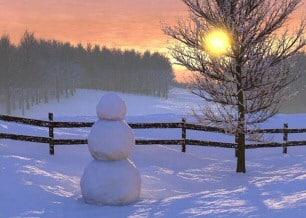
Please send us your mellow pictures of sunset.