
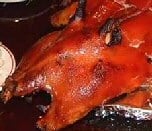
On this page we give you a flavour of traditional Chinese foods, together with the culture that accompanies this Lunar New Year festival.
China: Food Feast
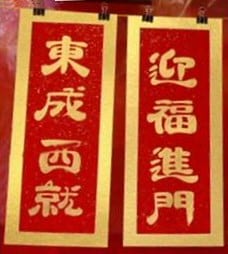
The Chinese New Year is a time for families to reunite, not only to welcome in the new lunar year, but also to feast together and wish each other good fortune. Preparations for this traditional occasion often begin the month before. Homes are swept and cleaned from top-to-bottom to rid the home of any bad luck that may cling and carry over to the New Year.
Red paper fortune scrolls, on which prosperous greetings and blessings are written, are put up around the home to ensure the household has an auspicious New Year.
New clothes and shoes may be bought, and hair cut to symbolise a fresh start. After these preliminary preparations, the focus shifts onto the food that will be eaten and served over the Spring Festival.
Traditional Chinese New Year Food Menus
Many new year dishes are served “whole”; such as whole fish, or whole chicken or duck, this is because the action of slicing and cutting carries bad connotations, like severing family ties.
At New Year, a special emphasis is placed on the symbols represented by different foods. Here is what we have discovered about what these traditional foods represent:
- Bamboo shoots: Wealth.
- Black moss seaweed: Wealth.
- Chicken: Represents happiness and marriage.
- Dried Bean Curd: Happiness.
- Eggs: Fertility.
- Egg Rolls: Wealth.
- Fish served *whole: Prosperity
- Chinese garlic chives: Everlasting, a long life.
- Lychee nuts: Close family ties.
- Noodles: Represent a long life.
- Oranges: Wealth.
- Peanuts: A long life.
- Pomelo: Abundance, prosperity, having children. (Pomelo is a citrus fruit native to SE Asia.)
- Seeds, e.g. lotus or watermelon seeds: Having a large number of children.
- Tangerines: Good luck.
* Whole fish is often seen on the menu, as the Chinese adage ‘nian nian you yu’ in Mandarin, or ‘neen neen yau yu’ in Cantonese, which translates as ‘may you have abundance every year’.
Togetherness Food Tray
When visiting relatives, it’s customary for them to offer guests tea, along with a round or octagonal tray filled with a variety of treats, from nuts to sweets. This is known as “chyuhn haap”, or the Tray of Togetherness.
Traditionally, the tray is made of wood, with eight interior dishes of porcelain, but nowadays many people opt for plastic. Will and Guy have seen ones constructed from rosewood, which is very special. The tray usually contains an inner set of eight compartments to help keep the goodies separated. Each compartment is filled with a special symbolic food. In such a tray one might find: candied ginkgo nuts, red melon seeds, candied ginger slices, candied water chestnut, candied carrot and candied lotus root.
Guy’s favourite here is the water chestnut; while Will preferred the candied carrot.
The Foods Eaten At Chinese New Year Vary Between Regions
Northern Chinese, for example, will ring in the new year by making and eating dumplings -“jiaozi”, as their shape resembles gold ingots. The name “jiaozi” also sounds like the word for China’s earliest form of paper money, so dumplings are thought to bring wealth to those who eat them.
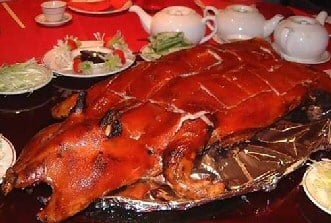
In the southern regions of China and Hong Kong, common celebration dishes are turnip cake – “loh bak go” and new year cake “neen go”. Traditionally, these were made in the home and then given to relatives as a token of love and respect, though the abundance of ready-made turnip and new year cakes in supermarkets and restaurants means that the laborious process of making these new year foods at home has largely been eliminated.
In walled village communities of China a fabulous meal called “poon choi” is created. This particularly appeals to Will and Guy as you can see when you read the ingredients. It is a hearty feast, often consisting of: pork, chicken, beef, duck, prawns, tofu, abalone*, dried mushrooms, Chinese radish, layered on top of one another and usually braised and presented in a wooden bowl from which all can share the food. The custom is for diners to help themselves to the food in the bowl, and the eating of “poon choi” is a communal activity and is considered important for family relations.
* Edible sea-snails [Will is not quite so keen now.]
I could pig-out on that crackling’, says Guy.
Food Specialities from the Regions of China
- Hunan dishes include spicy frogs’ legs, tripe and sea cucumbers.
- People from Sichuan eat duck intestines, pig brains, frog’s thighs, green bean seeds and rabbit ears.
- In Qinghai you can find sheep vein, yak vein, caterpillar fungus, a seaweed-like black moss known as “hair grass,” and stir-fried camel’s foot.
- Among the dishes one can find in Harbin are “yellow flower” (chopped lily stalks), grilled bear paw, stewed moose nose with mushrooms, white fungus soup, and monkey-leg mushrooms.
- In Manchuria, frog oil taken from frog ovaries is often added to soups and stews served at expensive restaurants.
- Yunnan favourites include live goat foetus, caterpillar fungus, three-year cured ham, fried goat cheese, and deep fried bee larvae.
- Delicacies from Hubei Province include snake meat, venison from spotted deer, soft-shell turtle and crocodile claw.
- Cobra-bile wine is consumed in Canton.
- People in Beijing like ant soup.
- Dog, known as “fragrant meat,” has long been a popular food in northeast and southern China and in recent years has become popular in other places.
Chinese New Year Lantern Festival
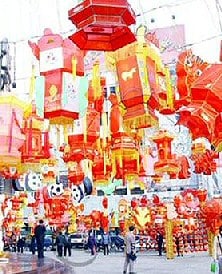
The Chinese Lantern Festival has a rich heritage. There are many wonderful stories about how the Lantern Festival first began. One story is that in ancient times, people would go in search of spirits with burning sticks. They thought the spirits could be seen during a full moon.
Chinese New Year Masks
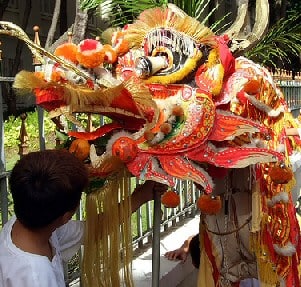
The Chinese masks that you see during the Chinese New Year Lantern Festival are exclusively used during that time of the year only. The general feeling generated by the Chinese masks during this festive season is that of happiness and joy.
Please write to Will and Guy if you have any pictures of traditional Chinese New Year foods.